While searching for my graduation project topic, I kept asking myself the same question: how do I create an experience that makes people truly feel something?
Traditional media — film, music, text — can describe alienation, escapism, imagination. But Virtual Reality can induce them. Physically placing the user inside a metaphor, transforming abstract concepts into tangible experiences — this is something no other medium can offer.
Throughout this journey, my project advisor Prof. Dr. Tolga Tüzün guided me — from shaping the concept to clarifying technical decisions at every stage.
Motivation: Capitalist Alienation
Modern capitalist societies often foster feelings of alienation and monotony, particularly within industrial or repetitive work environments. For many individuals, daydreaming serves not just as a distraction, but as a critical coping mechanism — a form of psychological resistance to reclaim agency in a world that demands conformity.
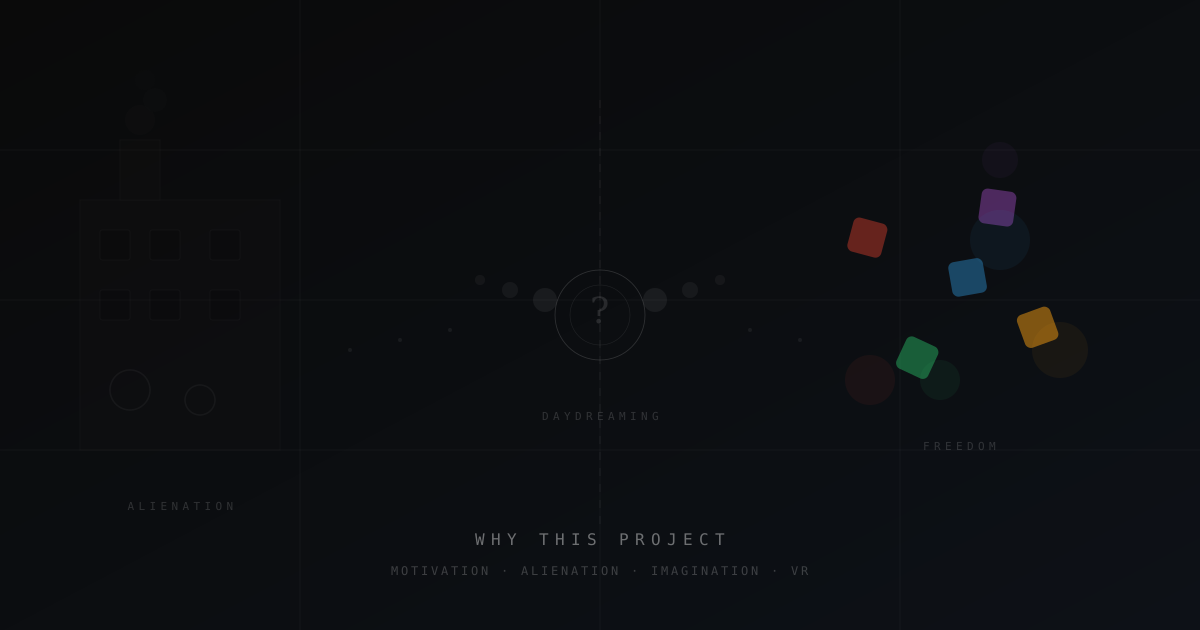
I drew from Marx's concept of alienation: the detachment of workers from the products of their labor, from the act of production, and from their own humanity. The factory is the perfect metaphor for this detachment. Reducing the user to a function — sorting cubes — under rigid quotas and the symbolic pressure of time... this is a concentrated version of what many of us feel in daily life.
Maladaptive Daydreaming
During my research I discovered Eli Somer's 2002 study. Maladaptive daydreaming describes extensive fantasy activity that replaces human interaction — a phenomenon where individuals become deeply absorbed in vivid, elaborate inner worlds, sometimes as a coping mechanism for stress or dissatisfaction with reality.
This concept deeply resonated with me because VR offers exactly this parallel: a technological extension of the mind's capacity for immersive fantasy. I wanted to intentionally blur the line between healthy escapism and maladaptive detachment.
Surrealism & the Subconscious
I drew inspiration from André Breton's 1924 Manifesto of Surrealism. A surrealist aesthetic to represent the inner world — a dreamlike, fluid experience that departs from the rigid logic of the real world. Color-reactive walls, anomalous objects, unconventional interactions — all reflecting the ever-changing nature of the subconscious mind.
The Problem: Making the Abstract Tangible
The core question was: how can immersive technology represent abstract psychological concepts like alienation, dissociation, and escapism? Traditional storytelling can describe these states, but VR can induce them.
My solution was a bifurcated spatial narrative: physically transporting the user from a restrictive, rule-bound environment to one of limitless possibility. Making them experience the jarring transition between these two states of being firsthand.
Inspirations
Radiohead and Epic Games' Kid A Mnesia Exhibition (2021) was a major inspiration — their approach to combining music and visual art in immersive digital spaces. Additionally, the hand tracking and mixed reality capabilities offered by the Meta Quest platform were what made the concept technically possible.
The Vision
The ultimate vision: a dynamic virtual environment where users interact with objects and systems through advanced hand tracking. Exploring procedural content generation, real-time feedback, and advanced user interaction paradigms in a VR/MR context. Creating two contrasting worlds — one crushing and monotonous, the other liberating and surreal — and transporting the user between them.
And so the project's first scene, "The Shift," was born — the beginning of a journey that would grow into Mind Palace.